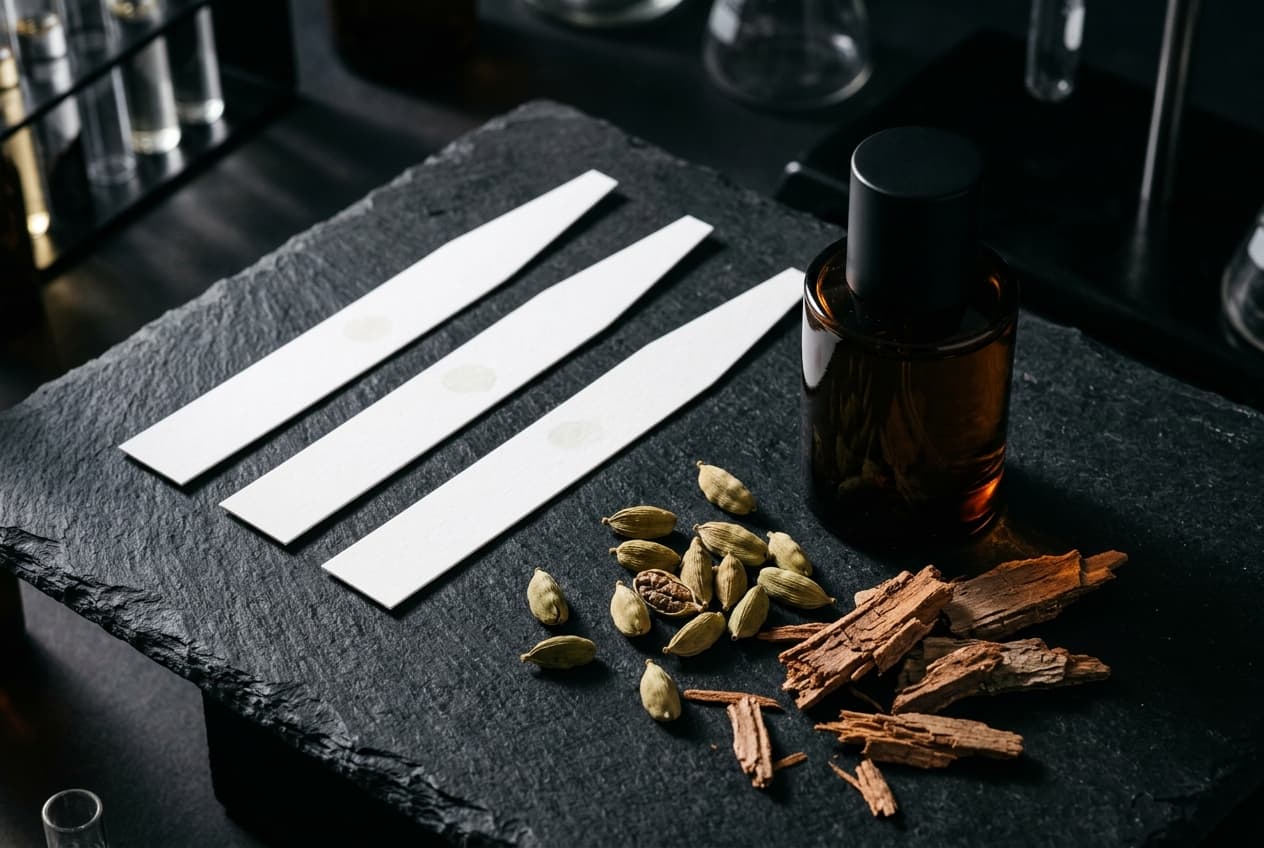
The Paper Blotter Trap: How Department Stores Con You in 15 Seconds
You spray a perfume, love it for ten minutes, and then it turns into something else entirely. An hour later it has shifted again. That is not the fragrance going wrong — it is the fragrance doing exactly what it was built to do. Every scent is designed to unfold in three acts, and once you understand those acts, you stop buying perfume by the first spray and start choosing it by how it actually lives on your skin.
Those three acts are called notes. Here is what each one means, and why it matters.
What is a fragrance pyramid?
A fragrance pyramid is the map of how a perfume reveals itself over time. It has three layers — top, heart, and base — and they do not arrive all at once. They evaporate in sequence, from lightest to heaviest, so the scent you smell at minute one is not the scent you wear at hour four.
Perfumers build in this order on purpose. The lightest molecules greet you first and then step aside; the heaviest hold on for hours. Think of it less like a single smell and more like a piece of music that changes movements while it plays.
Top notes — the opening
Top notes are what you smell in the first few minutes. They are made of small, light molecules that evaporate fast, which is why they are bright, fresh, and fleeting — usually gone within fifteen to thirty minutes.
This is the first impression, the part that makes you reach for the tester again. Common top notes are citrus (bergamot, mandarin, grapefruit) and light spices (pink pepper, cardamom). They are not meant to last; they are meant to introduce. Judging a perfume by its top notes alone is like judging a film by its opening credits — you are missing the whole story. You can see the exact top notes behind each AURĒ essence on the ingredients page.
Heart notes — the core
As the top notes fade, the heart notes step forward. This is the true character of the fragrance — what it actually is, once the opening flash settles. Heart notes last a few hours and form the body of the scent.
Florals live here most often: jasmine, rose, muguet. So do warmer materials like ginger and toffee. In Bloom, jasmine sambac sits at the heart, supported by white rose and muguet — the part you wear through the middle of the day. The heart is usually where you decide whether a perfume is really yours, because it is the part you live with longest before the base takes over.
Base notes — the foundation
Base notes are the heaviest, slowest molecules, and they are what remains after everything else has lifted off. They can last many hours — on a high-concentration extrait, well into the evening. This is the trail people notice after you have already left the room.
Woods (sandalwood, cedarwood), amber, musk, and vetiver are classic base notes. They do two jobs: they give the fragrance depth, and they act as fixatives, slowing down the lighter notes above them so the whole thing lasts longer. In Gravity, amberwood, vetiver, and dark musk form the base — the low, warm hum that grounds the entire composition. Without a strong base, even a beautiful opening disappears by noon.
How the three layers unfold on skin
Here is the sequence in real time:
- 0–30 minutes: top notes — bright, sharp, then fading.
- 30 minutes to 3 hours: heart notes — the main character arrives.
- 3 hours onward: base notes — the lasting, intimate drydown.
Two things change how this plays out. First, your skin: warmth, oil, and pH shift how notes read, which is why the same perfume smells slightly different on two people. Second, concentration. A higher concentration means the whole pyramid lasts longer and each layer holds its shape instead of collapsing. That is the difference between a scent that evolves gracefully over a day and one that flattens by lunch — and it is why AURĒ is built at 42%, nearly three times a standard eau de parfum. There is more on that in extrait de parfum vs eau de parfum.
How to actually smell the notes
Next time you test a fragrance, do this:
- Smell it immediately — that is the top.
- Wait twenty minutes, then smell again — the heart is arriving.
- Come back after a few hours — that is the base, and it is the one you will wear the most.
Do not rub your wrists, and do not decide in the first minute. The perfume you dismiss at the opening might be the one whose drydown you cannot stop smelling. Judge it by hour three, not second three.
The point
Notes are not marketing language — they are a timeline. Top notes introduce, heart notes define, base notes remain. Once you read a perfume that way, you stop chasing the first spray and start choosing scents that unfold into something worth wearing all day. That is the whole reason to build one properly, from the molecule up.