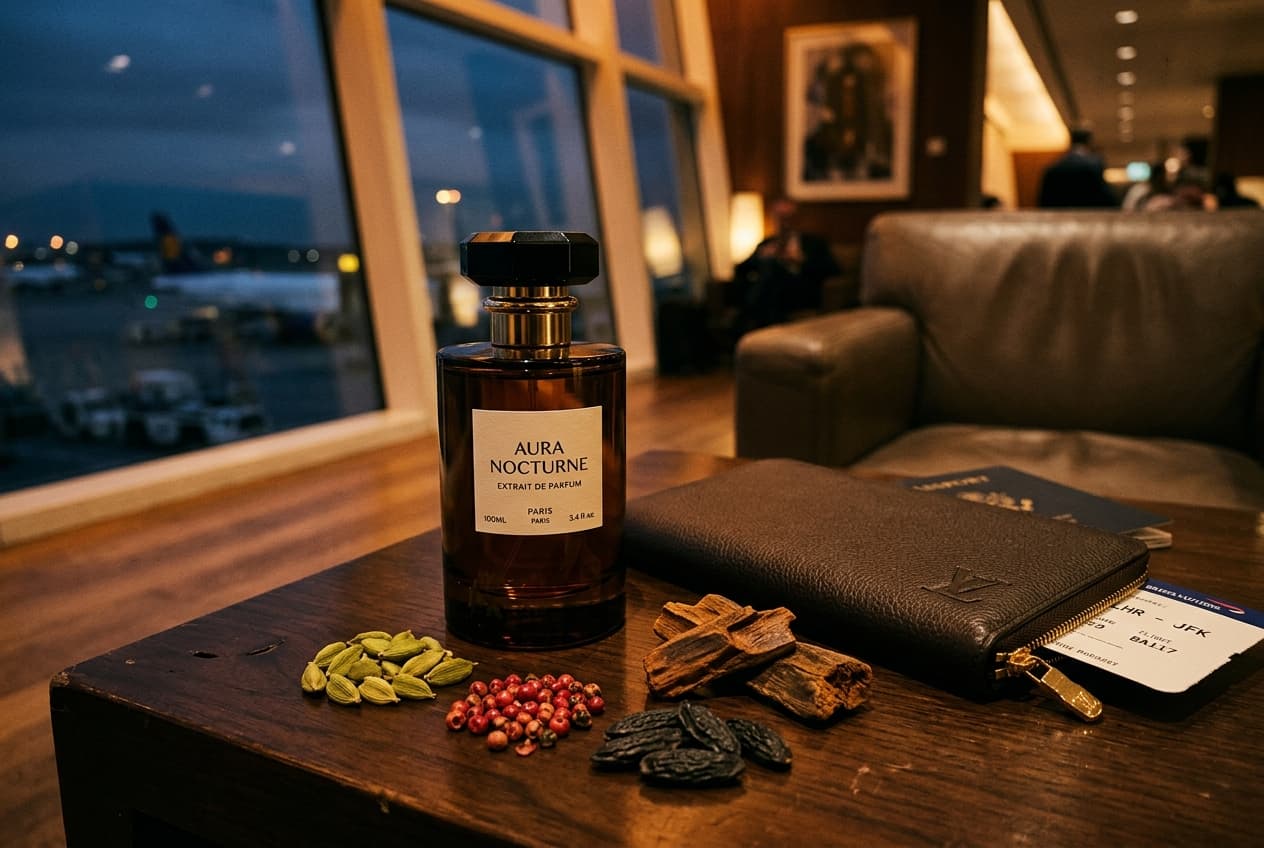
The ‘Airport Aura’: Why the Ultra-Wealthy Never Smell Fresh, Sweet, or Fruity
If you have ever walked through a First Class international airport lounge at midnight, you will notice something peculiar about the air.
Nobody smells like cotton candy. Nobody smells like synthetic green apples. And nobody smells like the sharp, screechy 'blue aquatic' shower-gel colognes that dominate duty-free retail shelves.
Instead, there is a quiet, low-humming scent in the air. A trace of cold cardamom, dry Haitian vetiver, warm bourbon vanilla anchored in smoky tonka bean, and polished amberwood. It doesn’t scream for your attention across an escalator, yet the moment someone walks past, you immediately register: that person is completely in control of their life.
In fragrance circles, this is known as the 'Airport Aura' — the invisible hallmark of quiet luxury. Here is why the ultra-wealthy gravitate toward this exact scent profile, and why the mainstream perfume industry has been steering you in the wrong direction.
1. The Supermarket Trap: The Addiction to Fast Sugar
To understand why quiet luxury smells dry, spiced, and woody, you first have to understand what mass-market perfume companies are actually doing.
Roughly 85% of mainstream designer perfumes sold in department stores rely heavily on two synthetic aromachemical categories:
- Ethyl Maltol & Vanillin Blends: Compounds that smell like caramel, cotton candy, and spun sugar.
- Dihydromyrcenol & Calone: The synthetic compounds responsible for that sharp, ozone, soapy 'clean linen/blue body wash' blast.
Why do mass brands do this? Because sugar and citrus trigger instant dopamine hits in the brain. When a casual shopper sprays a tester paper at a retail mall, the first ten seconds smell instantly sweet and punchy. They buy the bottle on impulse.
Thirty minutes later, the volatile top molecules burn off, leaving behind a flat, synthetic, alcohol-heavy skin scent that vanishes in Indian heat. Mass designer fragrance is engineered for the first spray purchase, not for all-day presence.
2. The Chemistry of Quiet Luxury: Why Dry Beats Sweet
True luxury fragrance operates on the opposite principle. It rejects the childish sugar-high in favor of high-molecular-weight structural compounds that unfold slowly over 10 to 12 hours.
Here are the three pillars of the Airport Aura:
Pillar A: Cold Spices Over Screechy Citrus
Instead of opening with cheap lemon or artificial grapefruit, sophisticated scent profiles open with green cardamom (α-terpinyl acetate) and pink pepper. Cardamom is clean and airy, but it carries a natural warmth and resinous depth. It announces presence without triggering an asthma attack in an airplane cabin.
Pillar B: Earthy Roots and Mineral Woods
The hallmark of old-world sophistication has always been Vetiver (Khus) and Cedarwood. Vetiver contains over 150 natural aromatic sesquiterpenes — earthy, slightly smoky, and deeply grounding. It smells like pressed linen, clean leather, and humid forest soil.
Pillar C: Resinous Gourmand Transitions
When quiet luxury uses vanilla, it is never sugary cake batter. It is Bourbon Vanilla and Tonka Bean (Coumarin) — smoky, nutty, and slightly bitter like dark cacao or cured tobacco leaf. It warms with skin temperature rather than turning sticky and cloying.
3. The Intimacy Zone: Sillage vs. Beast Mode Chokeholds
There is a misconception in the modern Indian fragrance community that the "best" perfume is the one that projects 10 meters and chokes an entire room (often called nuclear beast mode).
In refined spaces — business class flights, boardroom meetings, private dinners — loud, aggressive projection is considered a social red flag. It signals insecurity.
True luxury fragrance is built for the Intimacy Zone (arms-length sillage). It forms a personal magnetic field around your skin. People don't smell you before you enter the room — they smell a sophisticated trail after you walk past.
This is why high-concentration Extrait de Parfum (40%+ oil concentration) is the chosen format of connoisseurs. Extraits have a lower alcohol-to-oil ratio, meaning the fragrance doesn't violently evaporate into an aerosol cloud. It binds to the lipid barrier of your skin, releasing rich, mineral warmth continuously for hours.
4. Why Sweet Fragrances Fail in Indian Weather
If you live in India, wearing overly sweet or fruity perfumes is a recipe for disaster.
When high ambient temperatures (35°C–42°C) mix with skin perspiration and humidity, sweet gourmand notes ferment into something sticky, suffocating, and sour.
Conversely, spiced-woody structures thrive in heat. The warmth of your skin activates the dry cardamom and amberwood, amplifying the depth of the base notes without turning sour.
5. How to Build Your 'Airport Aura'
You don’t need to spend ₹35,000 on niche London or Parisian boutique bottles to achieve this scent profile. You only need to understand the architecture.
The Anatomy of the Aura:
- The Opening: Clean green cardamom, pink pepper, and sparkling bergamot.
- The Heart: Smoky tonka bean, bourbon vanilla, and dark resin.
- The Foundation: High-concentration amberwood, vetiver, and clean skin musk.
This exact architectural balance is the philosophy behind AURĒ Gravity. Formulated at a rare 42% Extrait de Parfum concentration, Gravity opens with hand-selected Kerala cardamom and pink pepper before descending into a 10-hour drydown of bourbon vanilla, tonka bean, and earthy vetiver.
It is dry, warm, and magnetic — built specifically to give you that effortless, commanding aura from the moment you step out of your door to the moment you land.
Explore AURĒ Gravity (50ml Extrait de Parfum) →
Or experience the complete scent architecture with the AURĒ Discovery Set (₹499) →