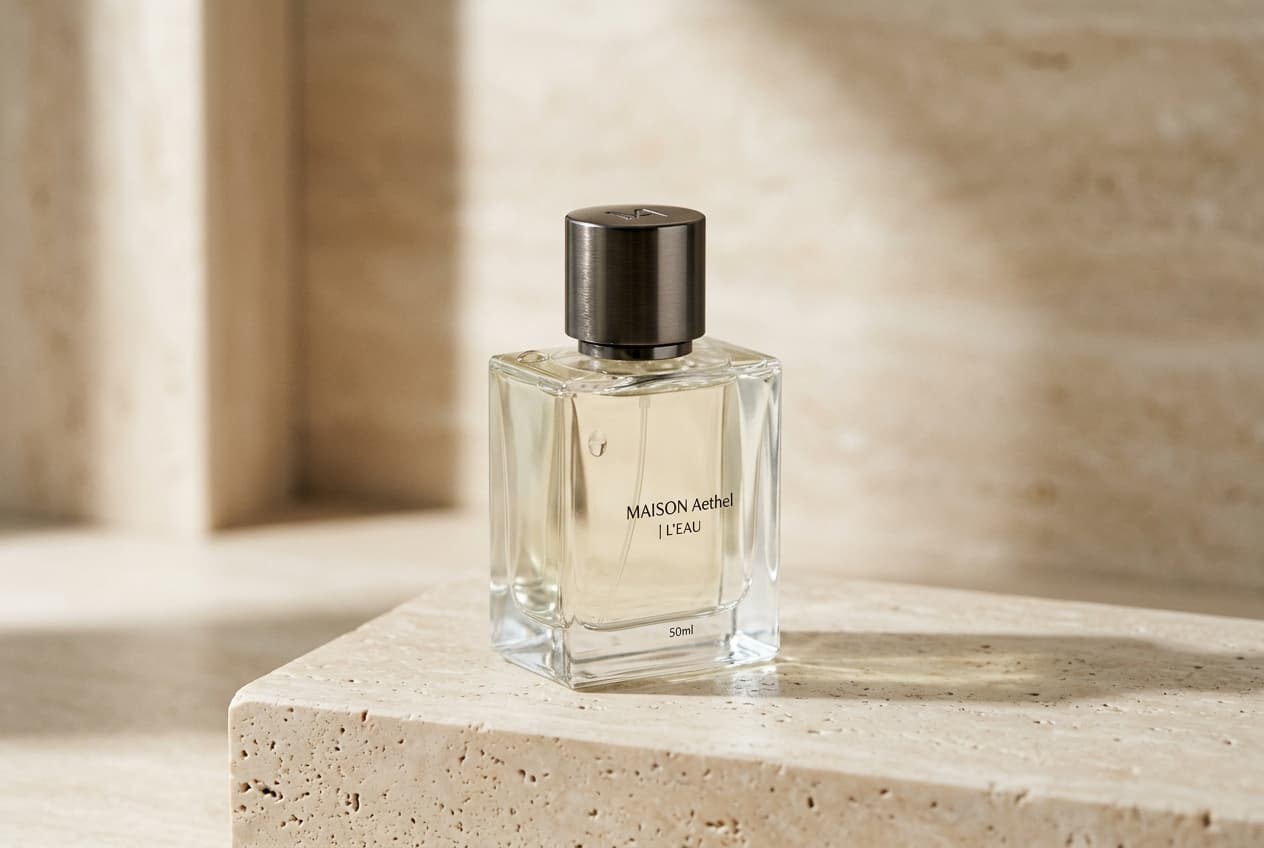
The Death of "100% Botanical": Why All-Natural Perfume Smells Like a Spice Cabinet After 1 Hour
Most perfume begins with a harvest. A field of flowers, a monsoon that arrived early or late, a crop richer this year and thinner the next. The perfumer works with whatever the season gives, which means the bottle you loved in spring can smell subtly wrong by autumn. For most of the history of perfume, that inconsistency was simply accepted as the romance of the thing.
We started somewhere else. We started with a molecule.
The difference between picking a scent and building one
Natural extraction is subtraction. You take a raw material — sandalwood, jasmine, vetiver — and pull the aroma out of it, along with everything else that happened to be in the plant that day. What you get is beautiful, and a little unpredictable.
Molecular perfumery is the opposite. It's addition. You begin with individual aromatic compounds, isolated, understood, stable, and you build upward, decision by decision, until the accord in front of you is exactly the one you meant to make. Not approximately. Exactly. The same in this bottle as in the next, in July as in January.
That can sound clinical until you smell the result. Precision isn't the enemy of feeling; it's what lets a scent hold a mood for nine hours without wandering into something you never asked for. Gravity opens on cardamom and settles through toffee, tonka, and dark musk in a line you can follow, because every step of that line was placed on purpose.
What obsession actually looks like
Obsession isn't a marketing word here. It's a description of the work. It's the gap between an accord that's "close enough" and one held back for weeks because the drydown turned half a degree too sweet at hour four. It's testing a base until Lucid still reads cool and clean at 2 p.m. in a Surat August, not just on a paper strip in an air-conditioned room.
It's deciding that 42% concentration — nearly three times the industry norm of 15% — isn't a headline number but a requirement, because presence that lasts a full day can't be faked with more alcohol. It's the refusal to round anything off. Every one of those choices is invisible in the finished bottle, which is exactly the point. You're not meant to see the work. You're meant to feel like the scent was always going to be this.
Why we build in Surat
There's a long assumption that this kind of precision has to come from somewhere else: a lab in Grasse, a house in Paris. We never accepted it. India carries three thousand years of scent in its bloodstream and, now, the science to build it molecule by molecule. Doing that here, in Gujarat, isn't a patriotic footnote. It's the whole thesis: that the most exacting fragrance you can wear doesn't need a foreign postcode to be real. There's more on where we come from on the about page.
A note only makes it in on merit
Building by addition means you can also subtract with intent. A compound that smells lovely on its own still gets cut if it blurs the line you're drawing. In a natural extract you take the whole plant, the parts you want and the parts you tolerate together. Here, nothing rides along by accident. If pink pepper sharpens Gravity's opening the way it should, it stays; if it tips the balance a degree too bright, it goes, and something else is tried in its place.
That sounds ruthless, and it is. It's also why the three essences don't read as variations on one house accord. Gravity, Lucid, and Bloom were each built to solve a different problem: presence in the dark, clarity in the heat, ease in a crowd. Same method, three deliberate destinations. Read them side by side in the journal and the through-line isn't a shared ingredient. It's a shared refusal to leave anything to chance.
What you're actually wearing
When you wear Bloom, you aren't wearing a field of jasmine that may or may not have had a good year. You're wearing a decision: jasmine sambac set against white rose and muguet in a proportion chosen and re-chosen until it read as warmth rather than performance. The romance isn't in the uncertainty. It's in the intent.
That's the trade we made. Less mystery about what's in the bottle, far more control over what it does to a room. We think that's the more interesting thing to make: a scent you can smell holding its shape at the end of a long day, exactly as it was designed to.
The point
A scent built from the molecule up isn't colder than one pulled from a flower. It's more deliberate. Every note is a choice someone refused to compromise on, compressed into fifty millilitres you'll wear without ever seeing the years behind it. That's the anatomy of obsession, and it's the only way we know how to make something worth wearing every day.