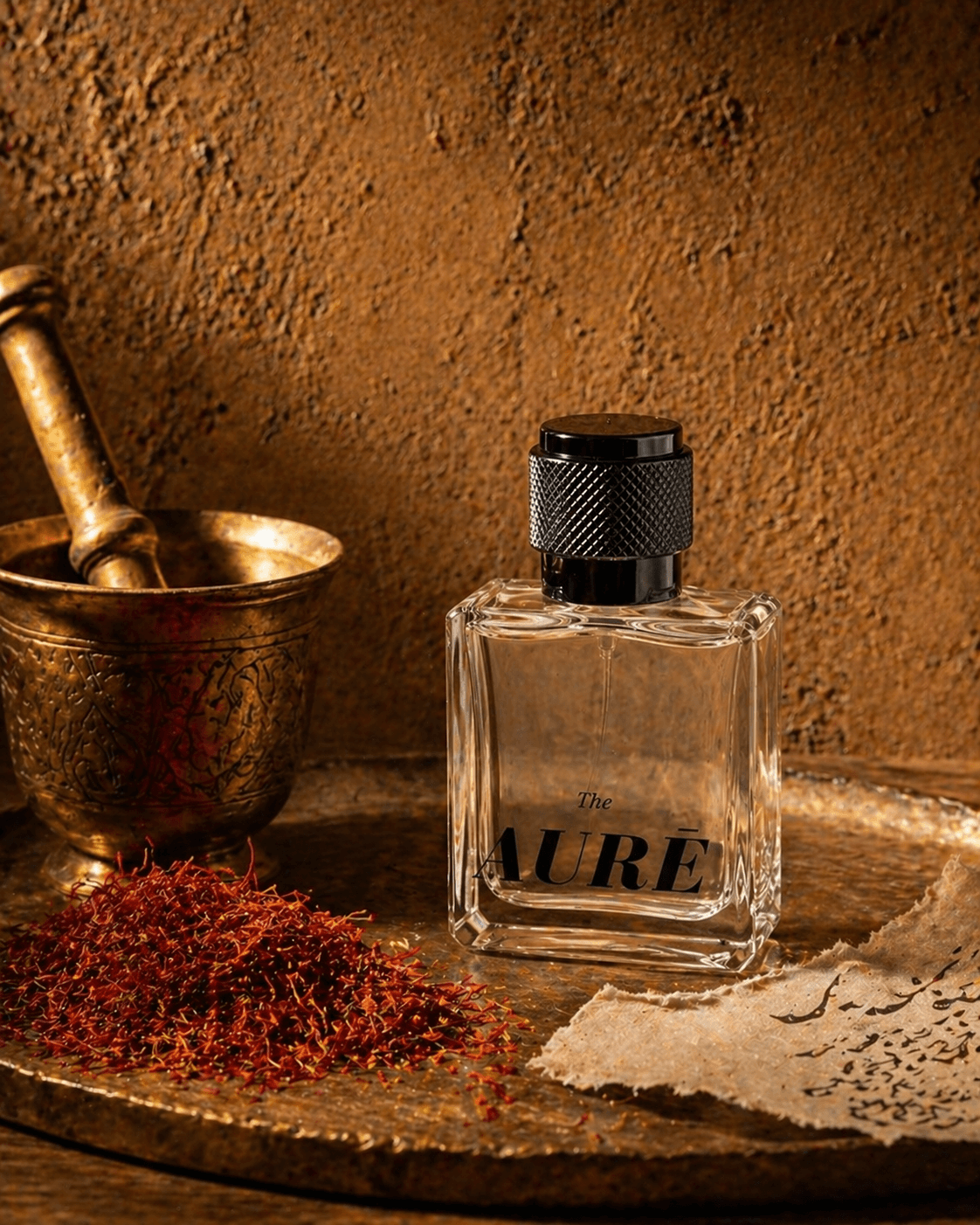
Three Thousand Years of Saffron
There is a passage in the Charaka Samhita — the foundational Ayurvedic text compiled around 400 BCE — that lists saffron among the most prized ingredients for anointing the body. Not for colour. Not for flavour. For scent. For the effect it has on the person who wears it, and on the people who encounter them.
Three thousand years of Indian sensory culture have agreed ever since.
In Mughal court perfumery, saffron was the substance that lent the great attars their warmth and depth. The Deccan Sultanates traded it alongside silk and gold. In Kashmir, where the saffron crocus grows with a specificity of microclimate that no other region in the world can replicate, the harvest has been called the most labour-intensive agricultural practice on earth — 150,000 flowers to yield a single kilogram of dried threads.
This is the material we decided to rebuild. Here is why, and what it took.
Why saffron is so difficult to capture in perfumery
The scent of saffron is the result of several distinct molecular compounds working together. The primary ones are safranal — formed during drying, not present in the living flower — along with picrocrocin and crocetin, which contribute to the distinctive hay-like, metallic, faintly sweet character. These compounds interact with each other and with other fragrance materials in ways that are difficult to predict and almost impossible to replicate convincingly at natural concentration levels.
Most saffron-marketed perfumes don't actually contain meaningful amounts of saffron extract. The cost is prohibitive — a kilogram of Kashmir saffron costs between ₹3,00,000 and ₹5,00,000, and you need a significant quantity to produce detectable saffron character in a fragrance. The result is that most "saffron" perfumes use lookalike molecules — things that gesture at saffron without capturing its specificity. They smell vaguely like what people expect saffron to smell like. Not like saffron itself.
The 14 attempts
When we began formulating our first extrait, we set ourselves one constraint: the saffron note had to pass a blind test against genuine Kashmiri saffron extract. Not "evocative of." Not "inspired by." Indistinguishable from — to trained noses who knew they were comparing.
The first formula smelled like hay. That was not a compliment. Hay is one of the compounds present in saffron's molecular structure, but it's the secondary character, not the primary. We had emphasised the wrong molecule.
Formulas two through six circled around the problem of metallic character. True saffron has a faint metallic quality — something almost mineral, like the scent of clean copper or wet stone — that distinguishes it from floral or resinous ingredients. Getting that quality without making the fragrance smell clinical was the challenge that consumed most of our first six months.
Formula seven introduced a combination of safranal with a small amount of iso e super — a synthetic woody-metallic compound — and something shifted. The metallic quality was present but felt warm rather than cold. The hay had retreated. We were in the right territory.
Formulas eight through eleven were refinements: adjusting the ratio of safranal to honey-like sweetness, working on the connection between the saffron note and the base (vetiver, oud, ambergris) that would carry it through the dry-down. The challenge was ensuring the saffron remained present at the end of a 12-hour wear, rather than burning off in the first hour.
Formula twelve passed the first round of blind testing. Two out of three evaluators couldn't distinguish it from the natural extract. The third could — and identified the specific quality she was missing, which took us to formulas thirteen and fourteen.
Formula fourteen passed unanimously.
The compound we'd been searching for in the final iterations was not one that appears in most perfumery reference texts. It's a degradation product of picrocrocin that forms during the aging of saffron strands. We found it by asking what happens to saffron that is eighteen months old rather than freshly dried.
Why bio-synthetic, not natural
The obvious question, which we were asked when we began talking about this, is: why not simply use Kashmiri saffron?
The answer is a combination of economics, consistency, and ethics — in that order.
At the concentration required to deliver genuine saffron character at 42% extrait, using natural saffron extract would make each 50ml bottle prohibitively expensive — not ₹29,999 but significantly more. The economics don't hold.
Beyond cost: natural saffron varies meaningfully between harvests. Kashmir saffron from a wet year smells different from a dry year. The saffron from one cooperative tastes different from another. In flavour, this variation is prized. In fragrance, where we're building a formula that should smell identical in every bottle, it's a formulation problem. Consistency in natural raw materials at this level requires either extremely large inventories (expensive) or regular reformulation (unacceptable).
And there is an environmental argument. Saffron cultivation in Kashmir is in documented stress from changing monsoon patterns and farming economics. The harvest is declining. The communities that have grown saffron for generations are under pressure. We did not want to be part of a supply chain that was adding demand to a strained system for a product that we could make more precisely without that strain.
Bio-synthetic saffron uses no agricultural land, no water, and no harvest labour. It produces a compound that is chemically indistinguishable from the natural version. The perfumery establishment has been slow to accept this, but the science is clear: what matters in a fragrance is the molecule, not its origin.
What this has to do with three thousand years of history
It would be possible to position what we've done as a break from the tradition — science replacing craft, the laboratory replacing the valley. We don't see it that way.
The Indian attar tradition, at its most precise, was always about capturing a molecular truth. The distillation of rose over sandalwood in Kannauj — a process refined over centuries — is an exercise in molecular separation and preservation. The perfumers who developed it were working with the same questions we work with: how do you capture this specific quality of this specific ingredient, and how do you make it last?
They didn't have mass spectrometry. We do. They didn't have the ability to isolate individual compounds. We do. The ambition is the same. The tools are different.
When we made formula fourteen — the one that finally passed — our master perfumer spent a long time with it before saying anything. Then she said: it smells like saffron that grew somewhere very specific. Not like a reconstruction. Like the real thing.
We considered that the end of the process. It was, in fact, the beginning.
The result of 14 iterations, 18 months, and one question worth answering.