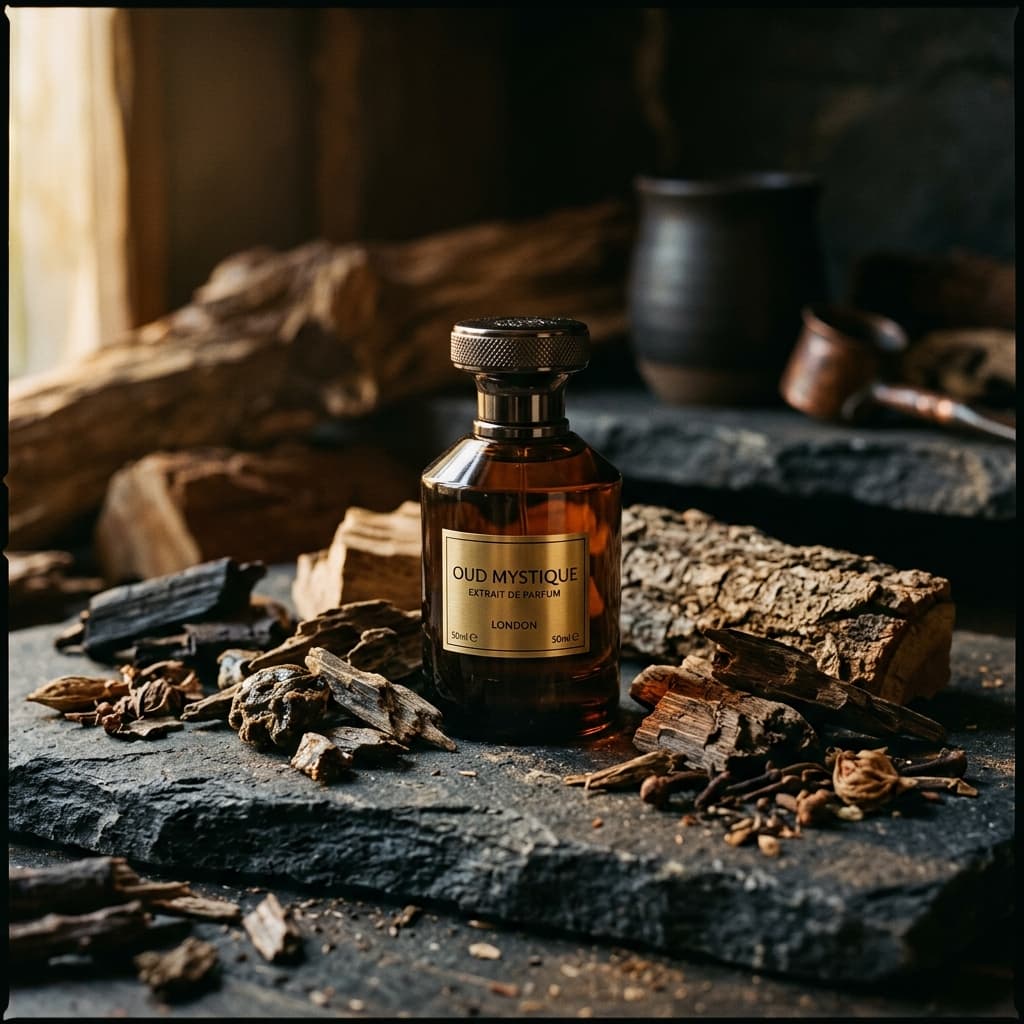
The ₹800 Oud Scam: You’re Spraying Petroleum Waste on Your Neck
Oud is the most expensive raw material in perfumery. By weight, it costs more than gold. A kilogram of high-grade agarwood oil can sell for ₹5,00,000 or more. And yet it's everywhere — in mall perfumes, in body sprays, in ₹500 bottles that claim to contain it.
Most of them don't. Not really.
This is the guide to understanding what oud actually is, why it smells the way it does, and how to find a fragrance that contains something worth the name.
What Is Oud?
Oud (also called agarwood, aloeswood, or oudh) is a resinous heartwood that forms inside Aquilaria trees when they become infected with a specific mould. The tree produces a dark, fragrant resin as a defence mechanism. This resin — which can take decades to develop — is what we call oud.
The scent is unlike anything else in perfumery. It's simultaneously woody, animalic, sweet, smoky, and medicinal. It has a depth that synthetic materials can approximate but never fully replicate. It evolves dramatically on skin over hours. It's the kind of smell that divides people immediately — some find it overwhelming, others find it the most beautiful thing they've ever smelled.
India has a long relationship with oud. Agarwood has been burned as incense in Indian temples and homes for centuries. The Mughal courts used it extensively. The attar tradition of Kannauj built some of its most prized compositions around oud as a base.
Why Oud Is So Expensive
Three reasons:
Rarity. Only a small percentage of Aquilaria trees develop the resin. The infection process is unpredictable and takes years. Wild agarwood is now endangered in most of its native range — India, Southeast Asia, Bangladesh — due to overharvesting.
Labour intensity. Harvesting and processing agarwood is extremely labour-intensive. The resin-saturated wood must be separated from the non-resinous wood by hand. Distillation is slow and requires significant quantities of raw material.
Time. The best oud comes from old trees — 50, 100, 200 years old. You cannot rush the process. The supply is inherently limited by biology and time.
The result: genuine high-grade oud oil is one of the most expensive materials on earth. Which is why most "oud" fragrances don't contain it.
What Most "Oud" Fragrances Actually Contain
The oud market in India is dominated by synthetic oud molecules — compounds that approximate the smell of oud without using actual agarwood.
This is not necessarily a problem. Some synthetic oud molecules are genuinely excellent. They capture specific facets of oud's character — the woody depth, the slight smokiness, the animalic warmth — in a consistent, affordable way.
The problem is transparency. Many brands use synthetic oud and market it as if it were natural. The price point is the clearest signal: a fragrance containing meaningful amounts of genuine oud oil cannot be sold for ₹500. The raw material alone would cost more than that.
What to look for:
- Brands that are transparent about whether they use natural or synthetic oud
- Price points that reflect the actual cost of the materials
- Descriptions that specify the origin of the oud (Indian, Cambodian, Hindi, Assamese)
The Different Types of Oud
Oud from different regions smells different. The variation is significant enough that experienced noses can identify the origin.
Hindi oud (Indian agarwood): The most animalic and medicinal. Deep, barnyard-like, intensely complex. Considered the most challenging and the most prized by connoisseurs.
Cambodian oud: Sweeter, fruitier, more approachable. The most popular in international luxury perfumery. Less challenging than Hindi oud.
Assamese oud: From Northeast India. Earthy, woody, with a distinctive green quality. Increasingly rare as wild Aquilaria trees in Assam have been heavily harvested.
Cultivated oud: Grown on oud farms, where the infection is induced artificially. More consistent and more affordable than wild oud. Quality varies significantly by producer.
How Oud Performs in Indian Weather
Oud is one of the best-performing fragrance materials in Indian heat. Here's why:
Oud molecules are high molecular weight compounds — they evaporate slowly. In 40°C heat, while lighter fragrance molecules are burning off the skin, oud stays. It's the anchor that keeps a fragrance present through the day.
This is why oud has been used in Indian and Middle Eastern perfumery for centuries. These are hot climates. The materials that survived and became traditional are the ones that worked in the heat. Oud worked.
For Indian consumers looking for longevity: a fragrance with genuine oud in the base will outlast almost anything else in the same conditions.
How to Wear Oud
Oud is intense. Less is more, especially if you're new to it.
Start with oud blends, not pure oud. Pure oud oil is an acquired taste. Most people find it overwhelming at first. A fragrance that uses oud as a base note — with florals, spice, or wood on top — is a better starting point.
Apply to warm skin. Oud's complexity unfolds with heat. Pulse points — wrists, neck — are ideal. The warmth of the skin is what activates the full character of the material.
Give it time. Oud fragrances change dramatically over the first two hours. The opening is often the least interesting part. The dry-down — what remains after the top notes have cleared — is where oud shows its real character.
Wear less than you think. Oud projects. One application to the neck is often enough for a full day. Two applications to wrists and neck is generous. More than that and you risk overwhelming the people around you.
Oud in Indian Perfumery Today
India is experiencing a genuine oud renaissance. After decades of importing oud-based fragrances from the Middle East, Indian brands are now making their own — using Indian agarwood, Indian attar traditions, and modern formulation techniques.
The best of these are genuinely world-class. They're not trying to replicate what Amouage or Creed does. They're doing something that only an Indian brand can do: making oud fragrances that are rooted in this country's specific relationship with the material.
At AURĒ, oud is a structural element in our compositions — not a marketing note. It's in the base, doing the work of anchoring the fragrance through 9–12 hours of Indian weather. That's what oud is for.
AURĒ makes extrait de parfum at 42% concentration. Oud as architecture, not decoration.