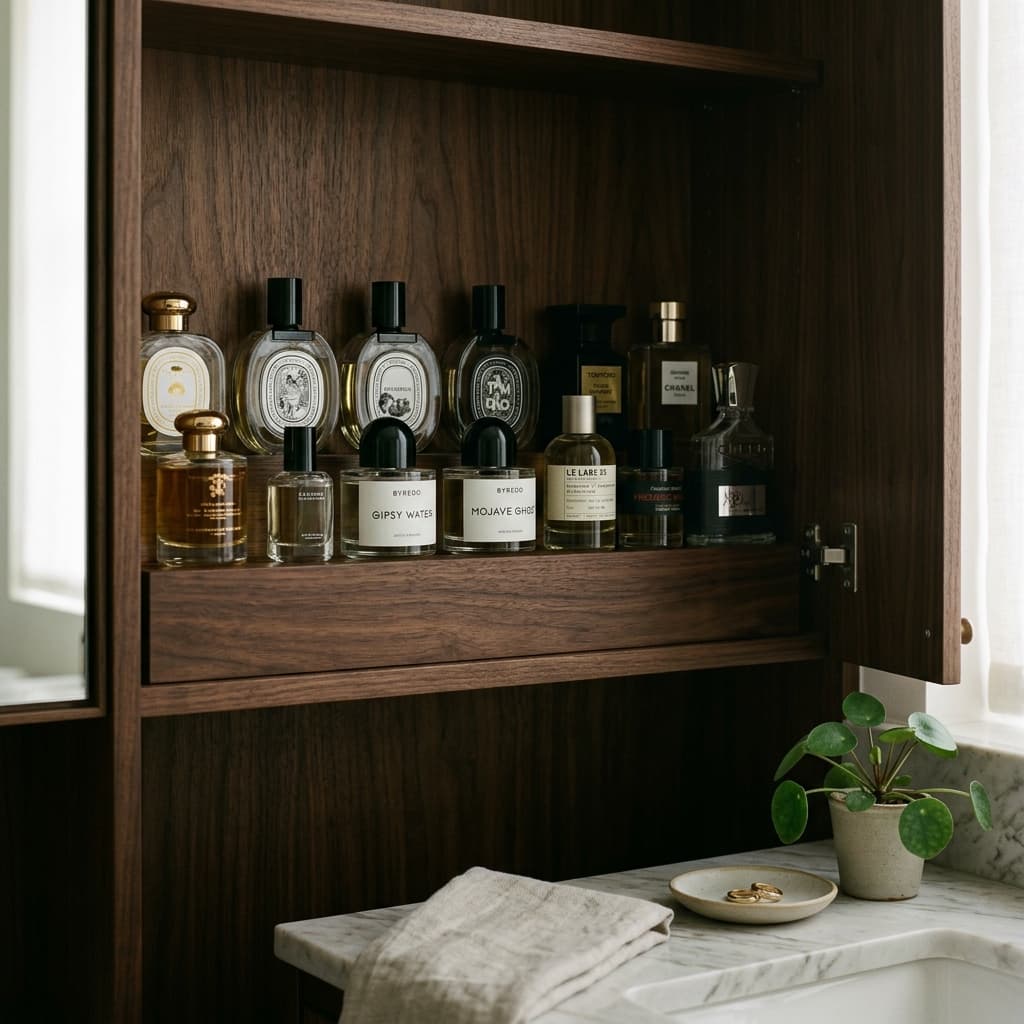
How to Store Perfume Correctly: The Mistakes That Are Ruining Your Fragrance
Most people store their perfume in the bathroom. The bathroom is the worst possible place for a fragrance.
Heat, humidity, and light — the three things that degrade fragrance compounds fastest — are all present in a bathroom in abundance. If you've ever noticed a perfume starting to smell slightly off after a few months, or losing its opening character, improper storage is almost certainly the reason.
Here's the science of what's happening — and exactly what to do instead.
What Degrades Perfume
Fragrance is a mixture of volatile organic compounds. These compounds are chemically reactive — they can oxidise, break down, and interact with each other in ways that change the scent over time. Three environmental factors accelerate this process:
Heat
Heat increases the kinetic energy of molecules, which accelerates chemical reactions. In a fragrance, this means oxidation happens faster, volatile top notes evaporate from the bottle even when it's closed, and the balance between fragrance compounds shifts.
The result: a fragrance stored in a warm environment will smell different — usually flatter, sometimes sour or off — faster than one stored in a cool environment.
In India, this is a significant issue. A bathroom that reaches 35–40°C in summer is actively degrading your perfume every day.
Light
Ultraviolet light is particularly damaging to fragrance compounds. Many aromatic molecules are photosensitive — they break down when exposed to UV radiation. This is why most quality perfumes come in opaque or dark-coloured bottles: the packaging is protecting the contents.
A perfume left on a windowsill or vanity in direct sunlight will degrade significantly faster than one kept in a drawer. The UV exposure is doing real chemical damage.
Humidity and Temperature Cycling
Humidity itself doesn't directly degrade fragrance, but temperature cycling does. When a bottle goes from cold (air conditioning) to warm (bathroom after a shower) to cold again, repeatedly, the expansion and contraction of the liquid can introduce air into the bottle and accelerate oxidation.
Bathrooms are the worst environment for this: the temperature swings between a hot shower and a cool room are exactly the kind of cycling that damages fragrance over time.
The Myths About Perfume Storage
"Store perfume in the refrigerator"
This is partially right and mostly wrong.
Cold temperatures do slow chemical reactions, which is why the logic seems sound. But the temperature cycling between fridge and room temperature — taking the bottle out every morning, warming it up, putting it back — causes more instability than it prevents.
The fridge also introduces humidity when you open and close it. And the smell of food can, over time, affect the fragrance if the bottle isn't perfectly sealed.
The exception: if you have a dedicated fragrance fridge that stays at a consistent cool temperature and you never take bottles in and out repeatedly, this can work. But for most people, a cool dark drawer is better.
"Shake the bottle before using"
Don't. Shaking introduces air into the fragrance, which accelerates oxidation. The fragrance is already mixed — it doesn't need agitation. Spray or apply directly.
"The bottle is sealed so it's protected"
Not entirely. Most spray bottles are not perfectly airtight. Over time, small amounts of air enter and oxidation occurs. This is normal and unavoidable — it's why fragrances have a shelf life. But improper storage accelerates the process significantly.
Where to Actually Store Perfume
The Ideal: A Cool, Dark Drawer or Cabinet
The best storage for most people is a drawer or cabinet away from windows and heat sources. Consistent temperature, no light exposure, low humidity.
A bedroom drawer is usually ideal. The temperature is relatively stable (especially if you use air conditioning), there's no direct light, and the humidity is lower than a bathroom.
The Box It Came In
If you have the original box, use it. The box is designed to protect the bottle from light and temperature fluctuation. Keeping the bottle in its box, in a drawer, is close to ideal storage.
Away from Windows and Radiators
This seems obvious but is frequently ignored. A perfume displayed on a windowsill looks beautiful. It's also being degraded by UV light every day. If you want to display your collection, keep it away from direct sunlight — a shelf on an interior wall, not a windowsill.
Not in the Car
Cars in Indian summer reach 60–70°C inside. A perfume left in a car will be significantly degraded within weeks. If you carry a fragrance for reapplication, keep it in your bag, not the glove compartment.
How Long Does Perfume Last?
With proper storage, most fragrances last 3–5 years from opening. Some last longer — particularly those with heavy base notes like oud, amber, and musk, which are more chemically stable.
Fragrances with high citrus or fresh top note content tend to degrade faster, because these compounds are more volatile and more reactive.
Signs that a fragrance has degraded:
- The opening smells sour, vinegary, or off
- The colour has darkened significantly (some darkening is normal)
- The fragrance smells flat — the complexity is gone
- It smells different from when you first bought it
If a fragrance has degraded, it's not harmful to wear — it just won't smell as intended.
Specific Tips for Indian Conditions
Monsoon season: Humidity spikes significantly during monsoon. Keep bottles tightly capped and stored in a cool, dry location. A dehumidifier in the room where you store your collection is worth considering if you have a significant investment in fragrance.
Summer: The biggest risk period. If your home doesn't have consistent air conditioning, consider moving your most valuable fragrances to the coolest room in the house during peak summer months.
Travel: Carry fragrances in your checked luggage rather than leaving them in a hot car or hotel room. Decant into small travel bottles rather than carrying full-size bottles that are more vulnerable to breakage and temperature exposure.
The Practical Summary
- Store in a cool, dark, dry location — a bedroom drawer is ideal
- Keep in the original box if possible
- Away from windows, bathrooms, and heat sources
- Don't shake the bottle
- Don't store in the car
- The fridge is not necessary and often counterproductive
- Tightly cap after every use
A quality fragrance is an investment. Proper storage is how you protect that investment — and ensure that what you smell in month twelve is as good as what you smelled on day one.
AURĒ makes extrait de parfum at 42% concentration. Built to last — on skin and on the shelf.