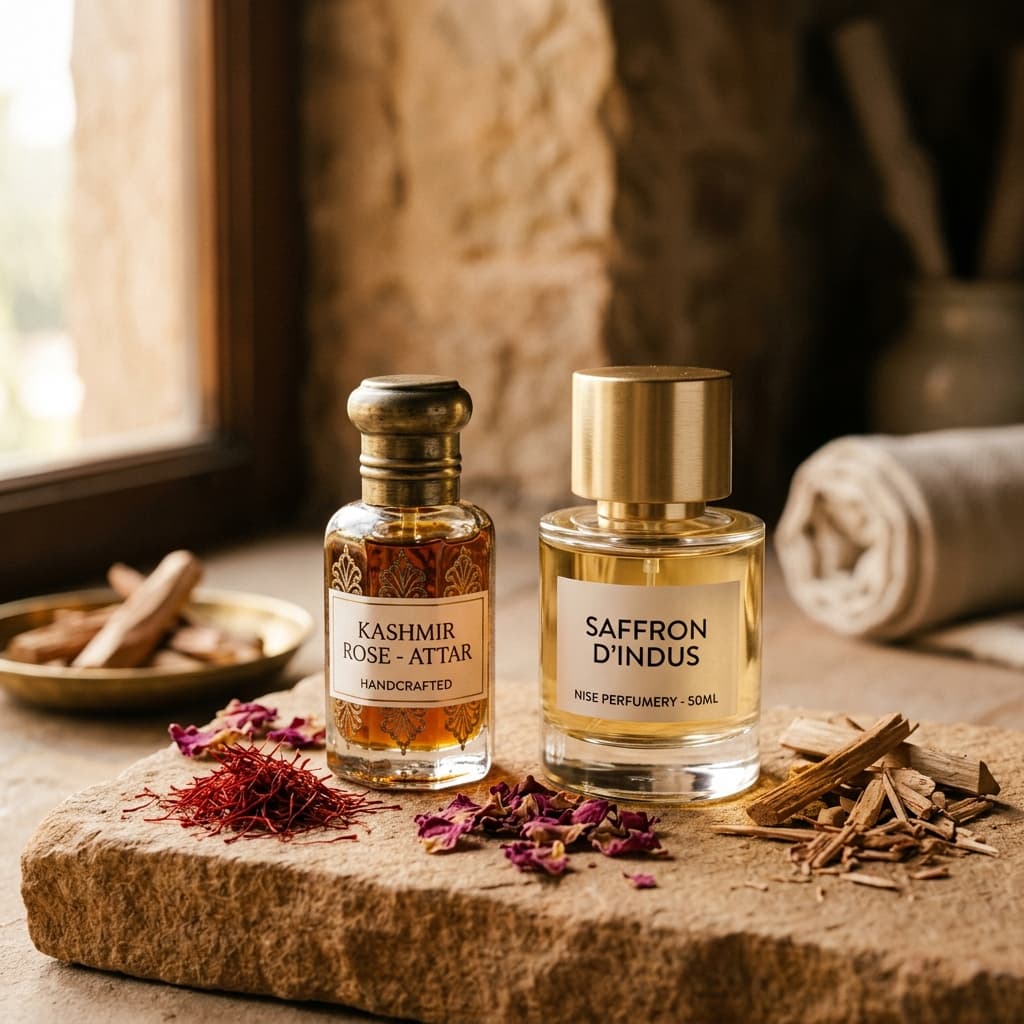
India Ruled the World of Fragrance for 400 Years. Then We Started Buying French Water.
Attar is older than the spray bottle by about three thousand years. It's also, in many ways, more sophisticated than most of what's sold in modern perfume counters. And yet most Indians under 35 associate it with their grandparents' generation and haven't thought about it since.
That's changing. Here's why — and what you actually need to know.
What Is Attar?
Attar (also spelled ittar) is a concentrated perfume oil made by distilling botanical materials — flowers, woods, spices, resins — into a base of sandalwood oil. The process is called deg-bhapka distillation, and it has been practiced in Kannauj, Uttar Pradesh, for over 400 years.
The result is a fragrance oil with no alcohol, no synthetic carriers, and a concentration that typically runs between 30–50% aromatic material. You apply it directly to skin — a small amount on the inner wrist, the neck, behind the ears — and it releases slowly as your body temperature warms it.
The most famous attars are:
Rose attar (Gulab): Made from Damask rose petals distilled over sandalwood. The most prized and expensive. A single kilogram requires thousands of kilograms of petals.
Jasmine attar (Chameli): Lighter than rose, with a green, slightly indolic quality that is different from synthetic jasmine in modern perfumes.
Mitti attar: The scent of rain on dry earth — petrichor, captured in oil. Made by distilling baked clay. One of the most distinctly Indian fragrances in existence.
Oud attar: Agarwood oil, the most expensive raw material in perfumery. Deep, woody, animalic, complex. The foundation of Middle Eastern and South Asian luxury fragrance.
What Is Modern Perfume?
Modern perfume — the spray bottle you buy at a mall — is a fragrance concentrate dissolved in alcohol. The alcohol is what carries the scent molecules off the skin and into the air, creating the projection and sillage that most people associate with perfume.
The concentration varies:
- Eau de Toilette: 5–15% fragrance in alcohol
- Eau de Parfum: 15–20%
- Extrait de Parfum: 20–42%+
The alcohol evaporates quickly, which is why modern perfumes have a strong opening that fades over time.
The Key Differences
Alcohol vs. Oil Base
This is the fundamental difference. Attar uses sandalwood oil as its carrier. Modern perfume uses alcohol.
Alcohol creates projection — the scent cloud around you. Oil creates intimacy — the scent stays close to skin, releasing gradually.
For Indian weather, oil has a practical advantage: it doesn't evaporate in heat the way alcohol does. An attar applied in the morning will still be present in the evening. An EDT in the same heat may be gone by noon.
Application Method
Attar is applied with a glass stopper or fingertip — a small amount, directly to skin. Modern perfume is sprayed.
The difference in application changes the experience. Attar is deliberate, intimate, almost ritualistic. Perfume spray is quick, easy, and designed for modern life.
Scent Profile
Attar tends toward natural, complex, evolving scent profiles. Because the ingredients are botanical and the process is traditional, the result has a depth and variation that synthetic fragrances often lack.
Modern perfumes use synthetic molecules for consistency and cost. This isn't inherently worse, but it is different. A synthetic rose smells the same in every bottle. A rose attar from Kannauj smells slightly different every season, because the roses are slightly different.
Longevity
Attar wins on longevity, almost always. The oil base anchors the fragrance to skin in a way that alcohol cannot. A good attar will last 12–18 hours on skin. Most EDTs last 3–5 hours in Indian conditions.
Skin Sensitivity
Attar is generally better for sensitive skin. No alcohol means no dryness, no irritation, no redness at application points. The sandalwood base is itself a skin conditioner.
Which One Is Right for You?
Choose attar if:
- You want maximum longevity without reapplying
- You have sensitive skin or react to alcohol-based products
- You prefer intimate, skin-close fragrance over projection
- You want something with genuine Indian heritage
- You want something that evolves over the day rather than fading
Choose modern perfume if:
- You want projection — a scent that fills a room or announces your arrival
- You prefer the convenience of a spray bottle
- You want a wide range of fragrance families and styles
- You want the option of lighter concentrations for different occasions
The honest answer for most people: both. Attar and modern perfume serve different purposes. An attar for daily wear — intimate, long-lasting, skin-close. A high-concentration extrait for occasions where projection matters.
The Modern Synthesis: Extrait de Parfum
There's a third category worth knowing: Extrait de Parfum at 40%+ concentration.
This is where modern perfumery meets the attar tradition. The concentration is high enough that the fragrance behaves more like an oil than a standard spray — it stays close to skin, evolves slowly, lasts 9–12 hours. But it uses the spray format and the full range of modern fragrance materials.
This is what AURĒ makes. It's not attar — it uses alcohol as a carrier and synthetic molecules alongside naturals. But the philosophy is the same as attar: high concentration, intimate sillage, longevity built for Indian weather.
The attar makers of Kannauj understood something that the modern Indian perfume market forgot: in this climate, concentration is not a luxury. It's a requirement.
Where to Find Good Attar in India
Kannauj, Uttar Pradesh, is the centre of Indian attar production. Several houses there have been operating for generations and sell directly or through distributors.
For a starting point: mitti attar (petrichor) is the most distinctly Indian fragrance you can try, and it's relatively affordable. If you've never smelled it, you should.
AURĒ makes extrait de parfum at 42% concentration — the modern synthesis of the attar tradition and molecular perfumery. Made in Surat.